
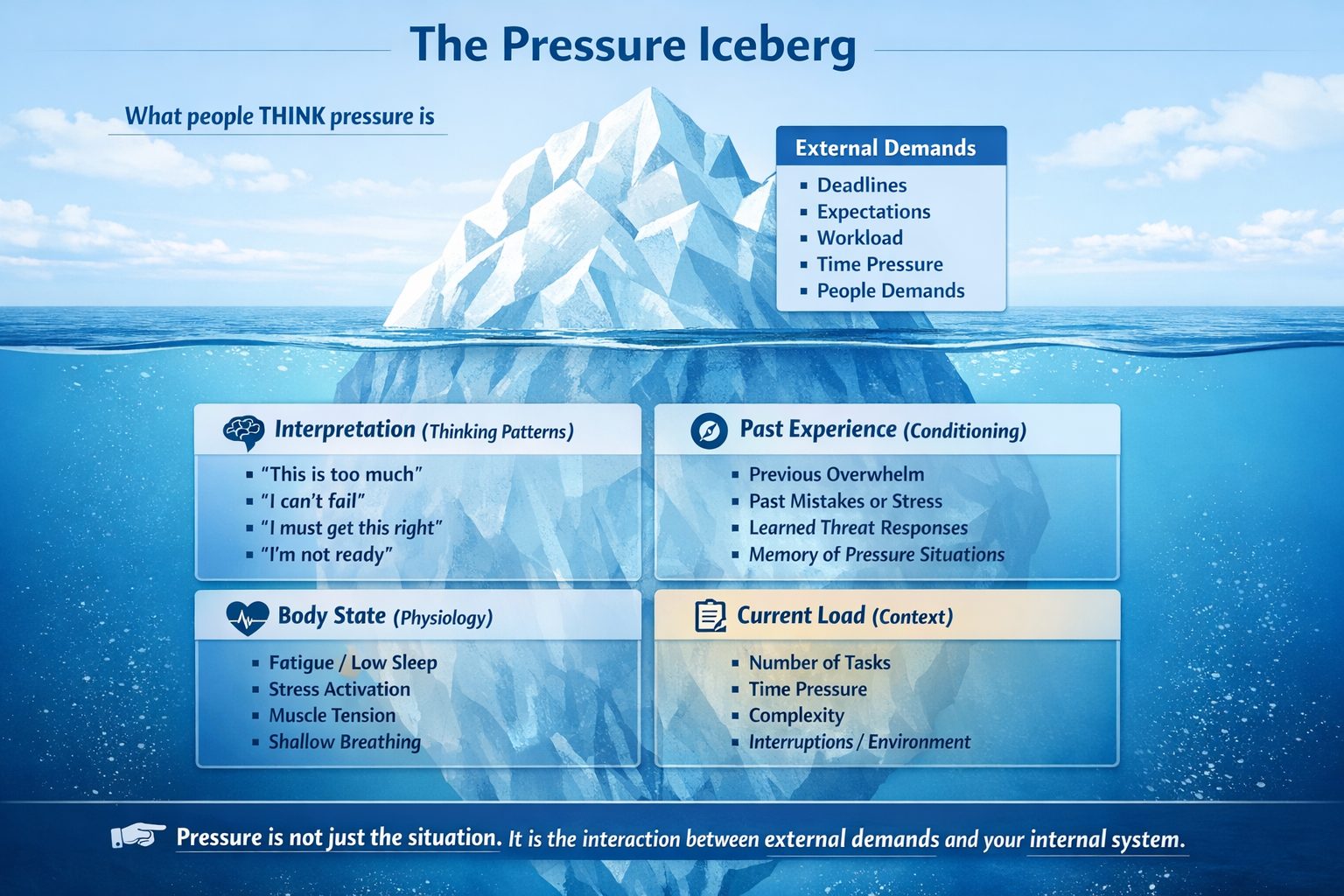
Before pressure affects performance, it affects how we think, feel, react, and relate.
Whatever roles we hold — managers, parents, partners, or leaders — we bring the same human responses to challenge, uncertainty, and stress. The pressures may differ, but the underlying reactions are often recognisably similar: defensiveness, over-control, withdrawal, overthinking, rushing, or shutting down.
When we understand our reactions under pressure, we create more choice in how we respond — with greater clarity and intention.
Before we lead others, we lead ourselves.
Understanding pressure
Sometimes, we all feel pressure.
Pressure to perform, to manage everything well, to say or do the right thing at the right time. To have things sorted — at work and in life.
Sometimes that pressure comes from outside us — deadlines, conflict, expectations, uncertainty, or simply too much to carry. A difficult colleague. A child struggling. A decision with consequences.
Sometimes we create pressure internally — through perfectionism, assumptions, self-criticism, or fear of getting it wrong.
Pressure is not only what is happening around us. It is also shaped by how we experience what is happening.
Pressure is rarely just one thing. It is an interaction between what we are carrying, how we are interpreting what is happening, and the state we are in when it happens.
Pressure may be shaped by what demands we are carrying, how threatening we perceive the situation to be, what support or resources we have available, the story we are telling ourselves about what is happening, and our physical and emotional state in that moment.
This is why the same challenge can feel manageable one day and overwhelming the next.
State matters. Interpretation matters. Capacity matters. And so does the environment around us.
And that creates possibility.
Because if pressure has several drivers, there are also several places where we can intervene and influence how we respond to it.
Two people can face the same challenge — a difficult conversation, tension at home, a presentation, a setback — and experience very different levels of pressure.
Why?
Because pressure is not only the event. It is what the event means to us in that moment — how threatening it feels, what resources we believe we have available, and the state we are in when it happens.
That helps explain why one person experiences feedback as an attack while another experiences it as a challenge.
Why one person spirals in conflict while another stays steady enough to listen.
Why uncertainty can trigger over-control in one person and thoughtful problem-solving in another.
The difference is not only competence. It depends on how a person regulates under pressure, how they interpret what is happening, and how much capacity (emotional, mental, and physical) they have available. These are not fixed traits — they are skills and patterns that can be strengthened over time.
Pressure is inevitable. Your response is trainable.
What pressure can do to thinking and behaviour
Most people do not struggle because they are incapable.
They struggle because they are under pressure.
And pressure changes how we think, respond, and communicate.
Attention narrows. Thinking becomes less flexible. It becomes harder to prioritise clearly, hold complexity, or see the wider picture. Communication can also become less clear.
We may rush decisions, over-control, catastrophise, go quiet, react too quickly, or say something we regret — often without realising that pressure is shaping the response.
What can look like poor communication, resistance, or difficult behaviour is often people operating under pressure, where reactions become more automatic and protective.
Threat responses under pressure
When challenge begins to feel like threat, protective reactions can intensify.
Some people fight — becoming sharp, defensive, controlling, or argumentative — especially when they feel a loss of control, fear failure, or feel their competence is being questioned.
Some flight — avoiding, withdrawing, or delaying — when things feel overwhelming or conflict feels like it may escalate.
Some freeze — feeling stuck, unable to think clearly, or going quiet — when there is too much uncertainty, complexity, or pressure to process.
Some fawn — becoming overly helpful, agreeable, or focused on keeping others comfortable — when there is a threat to connection, approval, or fear of rejection.
These are the body’s natural responses to stress.
In everyday life, they can look much more ordinary: defensiveness in a meeting, withdrawing in conflict, over-explaining when challenged, micromanaging when uncertainty rises, shutting down in a difficult conversation at home, or saying yes when you mean no to avoid tension or disapproval.
These are not character flaws. They are familiar ways of responding under pressure.
What sits underneath them is usually a sense of threat — not physical danger, but a perceived threat to something important.
Most often, this comes down to:
- loss of control
- fear of judgement
- fear of rejection
- fear of conflict escalation
- overwhelm or too much load
- uncertainty without safety
At the core, these responses are driven by a perceived threat to safety, control, or connection.
And part of leading yourself well is learning to notice these patterns before they begin to drive behaviour.
Do we have default stress patterns?
People don’t have one stress response. They have tendencies that show up differently depending on context, relationships, perceived threat — and how safe or unsafe they feel with different people.
With one person, they may feel open and relaxed; with another who feels more overpowering or critical, they may become quieter, more guarded, or more reactive.
We can experience all four responses at different times. These reactions are not identity — they are what shows up in the moment under pressure.
Different parts of us emerge under different pressures.
So a more useful question becomes:
How do you tend to respond when you feel under pressure — and what is that response trying to protect?
Control? Approval? Safety? Space? Avoiding conflict?
There is no right pattern. But there is value in noticing yours — because awareness creates choice.
Pressure is not always the enemy
We often speak about pressure as though the goal is to eliminate it. But pressure itself is not always the problem.
Some pressure can sharpen attention. Some can mobilise energy. Some can help us rise to a challenge. Without challenge, we can drift into complacency.
Too little challenge can leave us disengaged. Too much can overwhelm us. But there is often a middle range where challenge stretches us without flooding us — and this is often where growth and performance are possible.
The issue is not pressure itself, but when pressure exceeds our capacity to stay steady and think clearly. That is when performance begins to suffer.
The goal is not permanent calm. It is maintaining enough steadiness and clarity to function well under demand.
That is not a personality trait. It is a capability. And it can be developed.
So perhaps the more useful question is not:
How do I get rid of pressure?
But:
How do I work more skilfully with pressure?
That is a very different question.
And a much more useful one.
Working more skilfully with pressure
It starts with noticing what is actually happening in the moment.
Noticing when attention narrows.
Noticing when thinking becomes faster or more rigid.
Noticing when we are starting to react rather than respond.
Then recognising what is driving it — not as a label, but as a signal.
Is this a moment of perceived loss of control?
A fear of judgement?
A threat to connection?
Or simply too much to carry right now?
Because pressure is not only external. It is also internal — shaped by state, interpretation, and capacity.
And when we can see that more clearly, we create space.
Space to pause.
Space to choose.
Space to respond rather than react.
Where change begins
We will all experience pressure. It is part of work, relationships, and life. The question is not whether we will feel it, but how aware we are when it begins to shape us.
Because in those moments, we are not just reacting to what is happening around us. We are also reacting from what is happening within us — our level of regulation, the meaning we are making, and the capacity we have available at that time.
And when we begin to notice that, something important shifts. We are no longer fully inside the reaction. There is a small space around it.
In that space, we can regulate — enough to steady ourselves again. From there, we can think more clearly, and respond with clarity and choice, rather than reactivity.
Not perfect responses. Not constant control. But moments of awareness where pressure no longer fully drives behaviour.
That is often where change begins.


