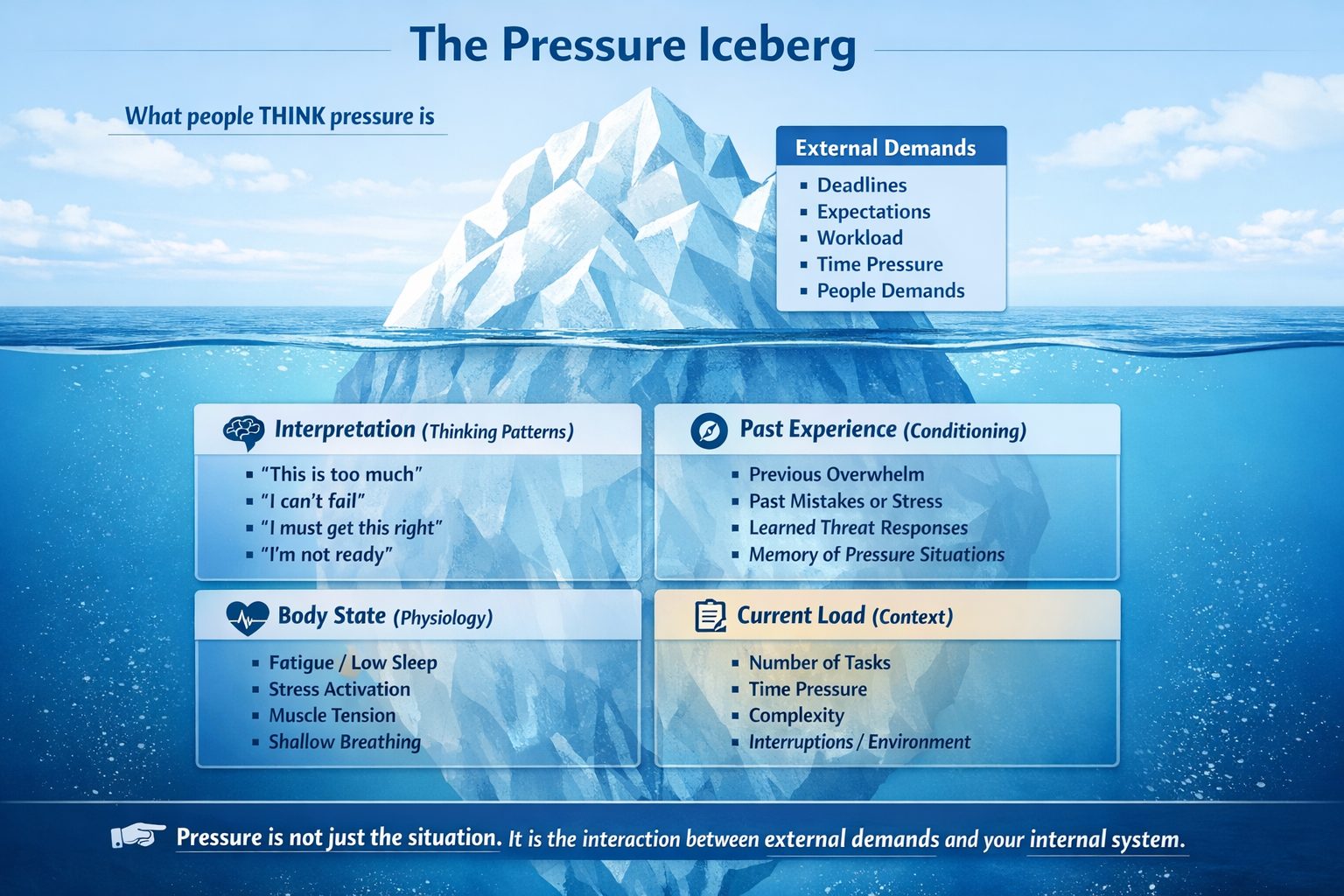
Most people don’t lose their ability under pressure.
They lose access to it.
In moments that matter — a difficult conversation, a decision under uncertainty, tension at work or at home — something shifts.
Thinking becomes faster, narrower, less flexible.
Communication becomes less clear.
Reactions become quicker, more automatic.
We interrupt. We over-explain. We go quiet. We push harder. We avoid.
Not because we lack skill — but because pressure is shaping how we think and respond in that moment.
The challenge is not pressure itself.
It is how we work with it.
What gets in the way of clear thinking
Under pressure, the brain shifts into protection.
Attention narrows. We focus on what feels urgent or threatening. It becomes harder to hold perspective, weigh options, or take in context.
We start to make quicker interpretations — often based on limited information — and treat them as fact.
A comment feels like criticism.
Silence feels like disapproval.
Uncertainty feels like risk.
From there, thinking speeds up — but clarity drops.
We may:
- rush decisions
- over-control
- catastrophise
- become defensive or reactive
It feels convincing in the moment. But it is rarely the full picture.
What gets in the way of clear communication
When thinking becomes less clear, communication follows.
We speak from reaction rather than intention.
That can sound like:
- pushing a point too strongly
- over-explaining to justify ourselves
- shutting down or saying very little
- agreeing too quickly to avoid tension
- reacting to tone rather than content
What often looks like “poor communication” is usually pressure in action.
And once the moment passes, we often think:
“That’s not how I wanted to handle that.”
The shift: from reacting to responding
Clarity under pressure is not about staying perfectly calm.
It is about creating just enough space to think and respond with intention.
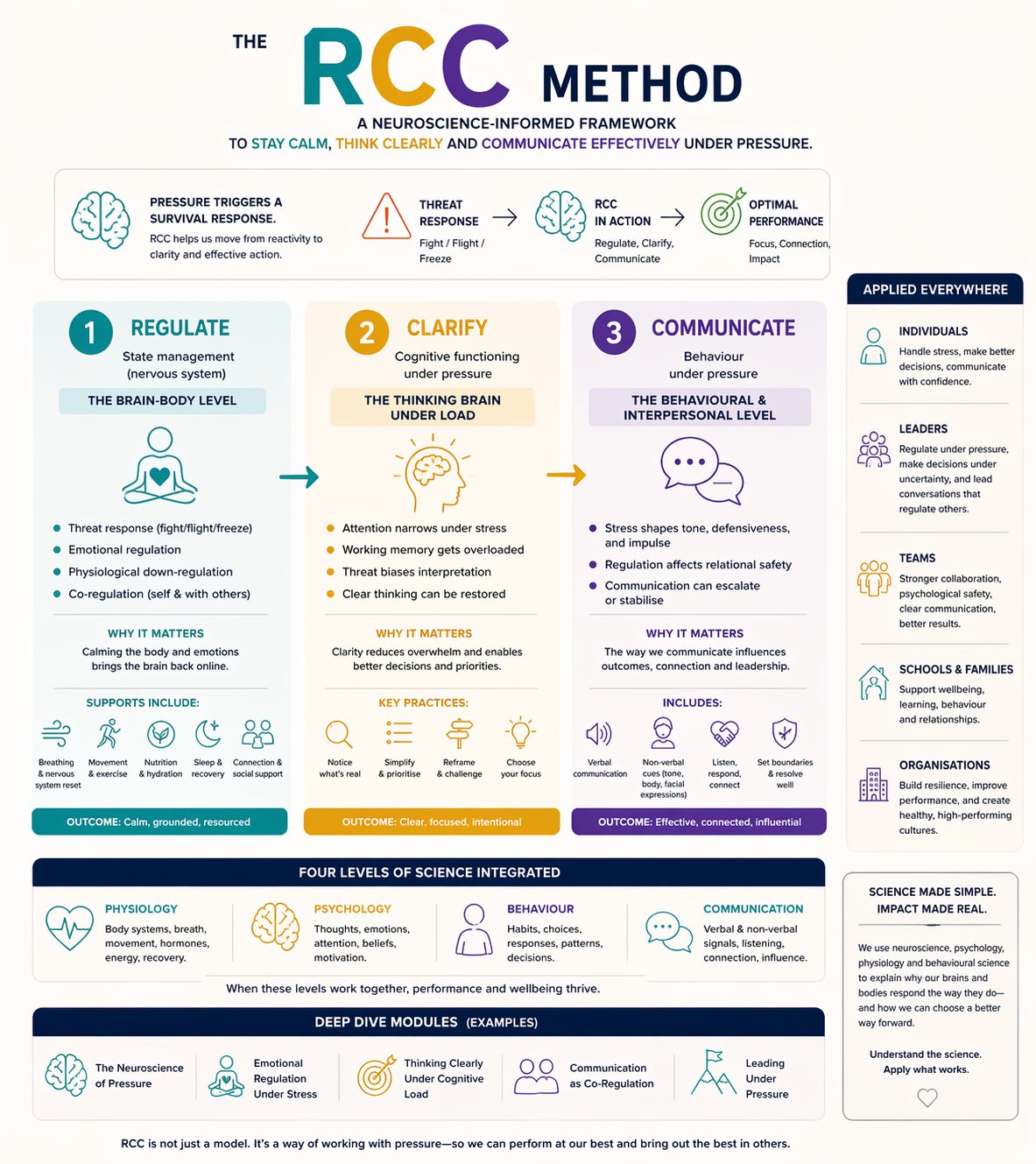
That requires three shifts:
1. Regulate: steady the system
Before you try to think clearly, you need enough steadiness in your body.
Because when the system is activated, clarity is limited.
This doesn’t mean “calm down completely”.
It means reducing the intensity enough to think.
Sometimes that is as simple as:
- pausing before responding
- slowing your breathing
- grounding your attention
- allowing a moment of silence
Small adjustments create space.
2. Clarify: recognise and reframe
Once there is a bit of space, you can begin to work with your thinking.
Instead of reacting to your first interpretation, you question it.
- What am I assuming right now?
- What else could be true?
- What actually matters here?
This is where clarity returns.
Not because the situation changes — but because your relationship to it does.
3. Communicate: respond with clarity
From there, communication becomes more intentional.
Instead of reacting, you respond.
That might sound like:
- “Let me think about that for a moment.”
- “Can we clarify what the main concern is?”
- “Here’s how I’m seeing it — what’s your view?”
- “I need a bit more time before I respond.”
Clear communication is not about saying more.
It is about saying what matters — with clarity.
In practice
This is not about perfect responses.
It is about catching yourself earlier.
Earlier in the reaction.
Earlier in the story.
Earlier before behaviour takes over.
Because the earlier you notice, the more choice you have.
Final thought
Pressure will always be part of work, relationships, and life.
The difference is not whether it shows up — but how you meet it.
When you can steady yourself, think clearly, and communicate with intention — even in small moments — everything begins to shift.
Not all at once.
But enough to change the outcome.